Reviewed · TOURS IN AGADIR
1 night in desert from Agadir
The best part of this two-day trip comes late in the first day, when you leave the paved road near El Borj and reach the sand dunes by a rough track. After mint tea and Moroccan pastries, you can climb the dunes for sunset, then return to a campfire dinner beneath a remarkably dark sky. Momo, also called Mohamed, is the guide most often associated with the trip, and his warm, attentive style adds a lot.
I like the way this tour joins the desert with the Atlantic coast rather than treating the night in camp as a stand-alone photo stop. Legzira Beach and historic Tiznit give you two very different tastes of southern Morocco, while dinner, music, and time with the local camp team bring a human side to the experience.
The main consideration is the amount of driving. You cover a great deal of ground in two days, and the desert near the camp may offer fewer broad dunes than you picture from classic Sahara photographs. If you want a long, deep-Sahara expedition, this is not it. If you want a compact taste of southern Morocco from Agadir, it is a strong option.
Key points to know before booking
- Sunset near El Borj: The camp is reached after about 45 minutes on a rough road, followed by tea, pastries, and time on the dunes.
- A coast-to-desert route: You visit Aglou, Legzira Beach, Sidi Ifni, and Guelmim before spending the night in camp.
- A local evening: Dinner, a campfire, and Sahraoui music by young local performers are included.
- Tiznit on the return: The second day includes the old medina, market, spring, silver shops, and ancient walls.
- A small maximum group: The tour accepts no more than 18 people, though some departures may feel more personal.
- Plan for extra costs: Dinner and breakfast are included, but lunch and drinks are not.
A desert night with a long, scenic approach
This is not a quick transfer to a camp followed by a morning drive home. The route makes southern Morocco the main event. You leave Agadir at 8:30 a.m. and follow the Atlantic coast toward Aglou, Legzira, and Sidi Ifni before turning inland through Guelmim and onward to El Borj.
I like that structure because the desert feels earned. You see fishing towns, sea cliffs, red rock, old walls, market streets, and dry inland scenery in one compact trip. You also get a better sense of how the coast and desert regions connect, rather than seeing only a prepared camp with no sense of place around it.
The tradeoff is simple: two days is a short time for a route this broad. You will spend many hours in the vehicle. The frequent stops help break up the ride, but you should still choose this trip because you are comfortable with a full touring day, not because you want a slow weekend.
Other trips people book in Agadir:
- Marrakech: Street Food Tour with a Local Guide
★ 4.9 · 3,119 reviews - Agadir or Taghazout: Paradise Valley Atlas Mountains Tour
★ 4.4 · 2,905 reviews - Agadir/Taghazout : Quad Bike Safari Desert
★ 4.8 · 1,496 reviews
Aglou begins the coastal run
After roughly an hour and a half on the road, the first planned pause is at Corniche Aglou. This is a short coffee break of about 15 minutes, taken beside the Atlantic Ocean.
Do not expect a long beach visit here. The value is practical. You get a chance to stretch, have coffee, and take in the sea before the day settles into its longer driving rhythm. If you prefer a trip with extended time at every stop, this pause may feel brief.
From Aglou, it is about another 30 minutes to Legzira. The route gives you an early taste of the coast before the larger scenic stop.
Legzira Beach and its red Atlantic arches
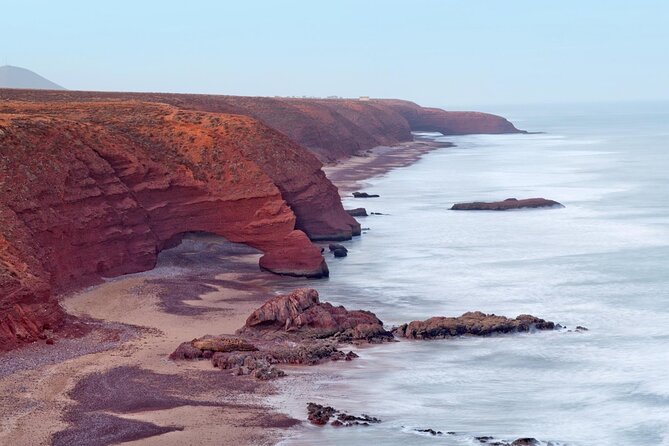
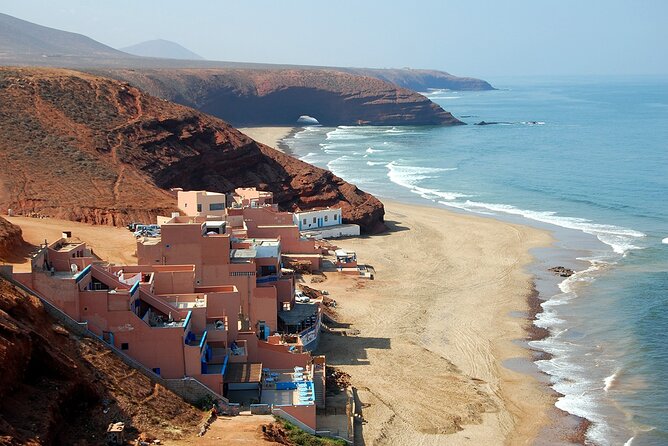
Legzira is the first major visual payoff. Its red earth and rock arches have been carved by the Atlantic, creating one of southern Morocco’s most recognizable shorelines. The beach is known for walking, surfing, and dramatic photography, although this tour allows about 30 minutes.
That short visit is enough for a look at the arches and a few photographs if the timing works well. It is not enough for a relaxed beach afternoon, a long walk, or a surf session. I would bring shoes that handle uneven ground and keep your expectations focused on a scenic stop rather than a full beach outing.
The setting also gives you a useful contrast with the desert later in the day. At Legzira, wind and waves have shaped the red rock. Near El Borj, sun and dry air define the experience. The two places are separated by hours of road, but they make sense together.
Sidi Ifni adds Spanish colonial character and lunch
About 15 minutes after Legzira, you reach Sidi Ifni, a former Spanish enclave. The stop lasts about an hour and a half, with lunch taken on site.
Lunch is not included, so budget for it separately. Local choices include grilled sardines, fried fish and chips, and other seafood dishes. This is one of the more useful places to spend money on food because the town’s Atlantic setting makes fish a natural choice, but the exact restaurant and price are not specified.
Sidi Ifni gives the route a different mood from Legzira. Instead of focusing only on scenery, you get time in a town shaped by Morocco’s more recent colonial past. Your guide can help explain the local setting, and the break gives you a chance to eat before the inland section.
Same base, a different sort of day:
- From Marrakech: Full-Day Trip to Agadir
★ 4.7 · 1,314 reviews - Agadir/Taghazout: Quad Bike and Sandboarding Tour
★ 4.7 · 1,286 reviews - Agadir: Crocoparc Skip-the-Line Entry Ticket
★ 4.8 · 1,268 reviews - From Taghazout or Agadir: Marrakech Guided Day Trip
★ 4.3 · 1,096 reviews
Guelmim, the inland gateway to the desert
The drive from Sidi Ifni to Guelmim takes about an hour. Guelmim is often described as the gateway to the Sahara and was once a caravan center on the route toward Timbuktu. It remains a place of trade between settled communities and desert nomads.
The tour includes a short visit and a tea break, within a stop of about an hour. If your trip falls on a Saturday morning, Guelmim is known for its large camel market, called Amhayrich. The market takes place only on Saturday morning, so do not assume it will be part of every departure. Its timing is a special possibility, not a standard promise of the trip.
This is a good place to understand the wider region. The desert is not simply empty sand. Towns such as Guelmim have long connected people, animals, goods, and routes between the coast and the interior.
Reaching the camp near El Borj
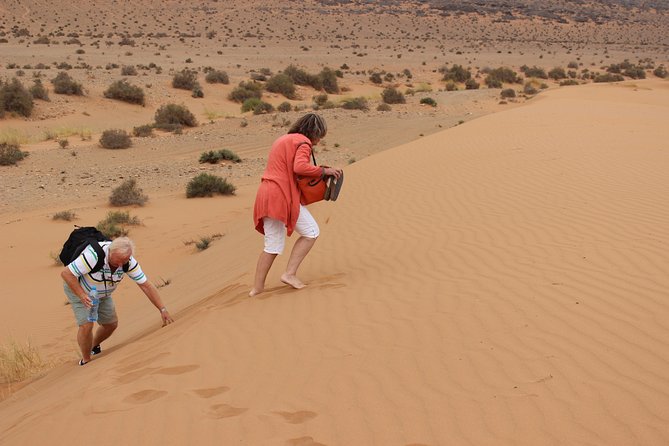
From Guelmim, the route continues for about an hour and a half to El Borj, a modest village associated with nomadic communities. From there, you take a rough road for roughly 45 minutes to the camp.
That final road matters. This is not a resort reached by smooth pavement. The rough surface is part of the remote setting, but it may be tiring after a long day in the vehicle. If you have concerns about motion or road comfort, ask the operator for current details before booking.
Once you arrive, the pace changes. You are served mint tea and Moroccan pastries, then given time to look over the dunes and watch the sun drop. This is the point when the long route begins to make sense. You are no longer passing through southern Morocco. You are spending the night in it.
Sunset, campfire dinner, and Sahraoui music
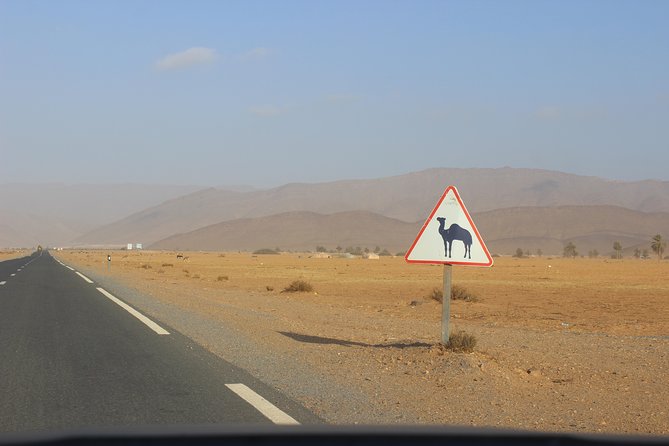
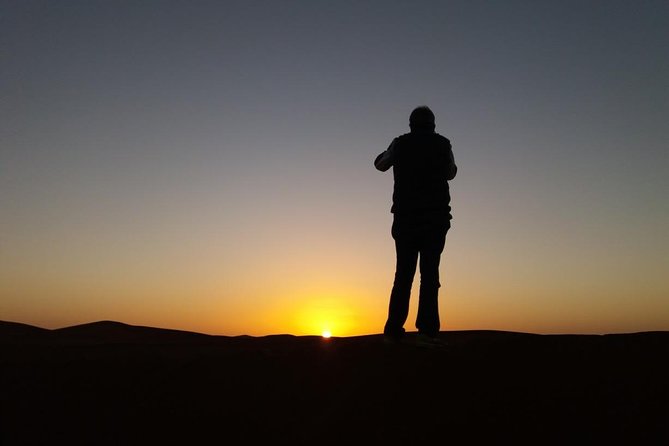
The sunset is the emotional center of the first day. You can walk up the sand dunes for a wide view, and several parts of the experience make this more than a quick stop for photographs. The changing light on the golden sand, the quiet around the camp, and the sense of distance from towns all work together.
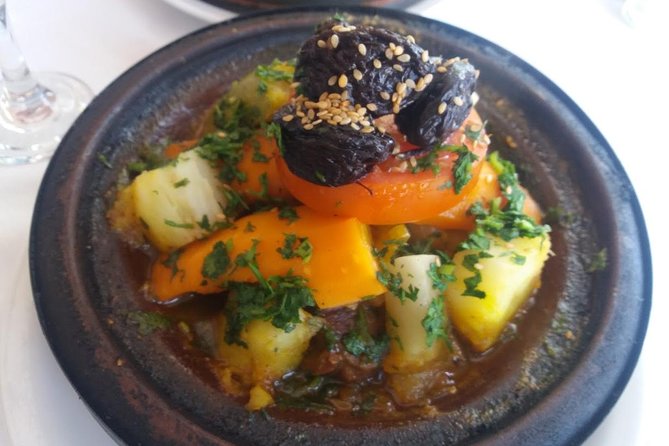
After sunset, dinner is served at the camp. Dinner is included, as is breakfast the next morning. The food described during the experience includes Moroccan cooking such as tagine, and the camp team has been praised for meals served in the tent setting. Do not expect a restaurant menu or a choice of many dishes. This is a set camp dinner, prepared for the group.
The evening continues around a fire with Sahraoui music performed by young local people. You may hear singing, see dancing, and take part in a relaxed celebration. Some departures have included extra touches for birthdays, anniversaries, or New Year’s Eve, but those additions should not be treated as guaranteed features.
The dark sky is one of the strongest reasons to spend the night. With little light pollution, you have a good chance to see far more stars than in Agadir. Several details in the experience point to a simple pleasure: sit outside, wrap up if the night is cold, and let the quiet do some of the work.
What sleeping in a nomad-style tent is really like
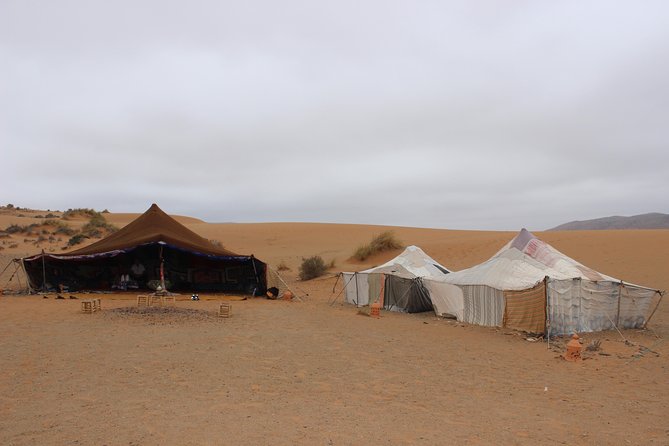
The overnight stay is in nomad-style tents at a desert bivouac. The appeal is the setting rather than luxury. You are sleeping close to the dunes, with the campfire and open sky nearby, instead of returning to a city hotel after sunset.
The tents are described as clean and thoughtfully arranged, and warm blankets have been provided during past stays. Still, this is camping in a remote area. You should book it for the atmosphere, the stars, and the cultural setting, not for a hotel-room experience.
Breakfast is included the next morning. Sunrise is available if you choose to get up for it. That choice is worth considering because the morning light can be beautiful, but you do not need to treat sunrise as a required part of the program if you prefer a slower start.
The return through Tiznit
The drive back toward Agadir takes you through Tiznit, reached about two hours after leaving the camp. The stop lasts around an hour and a half and includes the old medina, souk, spring, and ancient walls.
Tiznit is particularly known for silver jewelry. The market can be a good place to browse Moroccan craftwork, but keep your buying instincts in check. One account of the experience describes a silver seller as overly forceful, so you should feel free to look, compare, and walk away without pressure.
The old walls help give the town a clear sense of structure and age. The medina and souk are more than shopping stops, especially if you take time to notice how the town is arranged around its historic center. If you want to buy silver, ask about quality and price before committing. If you do not want to shop, make that clear and use the time to explore the streets and walls.
Momo and the guide experience
The strongest human element of this excursion is its guiding. Mohamed, often called Momo, is repeatedly identified with the experience. His role combines driving, explaining local customs, helping with practical needs, and keeping the long road days lively.
The most useful guide is not simply someone who points out sights. You want someone who can explain why Guelmim matters, help you understand the desert communities, and adjust the pace when a child, older relative, or tired passenger needs attention. Momo’s reputation for humor and care is especially useful on a route with so many hours in the vehicle.
The camp team also matters. Names that appear in the experience include Sahid, Haib or Habib, Abdul, Barack, and Rachid. The exact staff may vary, but the evening depends on local hosts who prepare dinner, welcome you with tea, and lead the music.
Price, group size, and practical value
At $232.63 per person, this is not the cheapest way to see southern Morocco, but it covers a lot: two-way hotel transfers from Agadir and nearby areas, transport, the desert camp, dinner, breakfast, the guide, and several major stops.
I see the value in the route rather than in the overnight alone. A one-night camp without the coast and Tiznit would be easier to find at a lower price. Here, you are paying for the long circuit, the driver-guide, the stops at Legzira and Sidi Ifni, the inland route through Guelmim, and the return through Tiznit.
Lunch and drinks are not included. Keep money available for the seafood lunch in Sidi Ifni and for drinks during the day. The tour accepts up to 18 people, though the actual feel can vary. Some departures may have only a few passengers, while others could be closer to the stated limit.
The tour is often booked about 29 days ahead. That does not guarantee that every date sells out, but it suggests that you should reserve ahead if your Agadir stay is short or your dates are fixed.
Who should book this two-day desert trip
I would choose this trip if you want one compact excursion that combines the Atlantic coast, local towns, desert scenery, food, music, and stargazing. It suits first-time visitors who want help with transport and interpretation rather than arranging several separate journeys.
Families can also consider it. A past departure included a three-year-old successfully, and the operator offers a child rate when the child shares with two paying adults. Even so, the long driving day and rough final road mean you should think carefully about your child’s comfort.
This is less suitable if you want deep sand dunes for hours, a private luxury camp, or a slow schedule. One useful warning is that the dunes near the camp may feel smaller or less extensive than expected. The trip offers a taste of the desert, not a full expedition into the far Sahara.
Most travelers can participate, and service animals are allowed. Pickup is offered from hotels in and around Agadir, and the meeting time is 8:30 a.m. Confirmation is provided at booking. Free cancellation is available up to 24 hours before the start time, with the usual restriction that late cancellations and late changes are not accepted.
Should you book it?
Book this experience if your main goal is variety and a memorable night outdoors. You will see a great deal of southern Morocco in two days, and the combination of Legzira’s red arches, Sidi Ifni’s coast, Guelmim’s desert connection, sunset near El Borj, and Tiznit’s old medina gives the trip real range.
Skip it if a long vehicle journey would spoil the fun or if your idea of the Sahara requires huge dunes stretching in every direction. For the right traveler, the appeal is not just sleeping in a tent. It is the complete route, the local dinner and music, the dark sky, and the chance to let Momo and the camp team handle the complicated parts.
FAQ
How long is the Agadir desert tour?
The experience lasts approximately two days and includes one night in a desert camp.
What time does the tour start?
The stated start time is 8:30 a.m.
Is hotel pickup available?
Yes. Two-way transfers are offered from hotels in and around Agadir.
What is included in the price?
Dinner and breakfast are included. Transport, the desert camp, and the scheduled touring stops are also part of the experience.
Are lunch and drinks included?
No. Lunch and drinks are not included, so you should budget separately for them.
Where do you sleep?
You sleep in nomad-style tents at a desert bivouac near the sand dunes reached from El Borj.
Is desert music included?
Yes. The evening includes Sahraoui music performed by young local people around a campfire.
Can I see the sunrise?
Yes. You can choose to get up for sunrise, although it is not required.
How many people can join the tour?
The maximum group size is 18 people.
Can I cancel for a full refund?
You can cancel at least 24 hours before the experience begins for a full refund. Cancellations or changes made less than 24 hours before the start time are not accepted.
Just added in Agadir
- boat trip from 9 am to 3 pm fishing & swimming & barbecue & dessert★ 4.0 · 36 reviews
- Sandboarding guided experience from Agadir&Taghazout★ 5.0 · 39 reviews
- Agadir airport Transfers to or from agadir hotels★ 5.0 · 66 reviews
- Jeep 4×4 Safari Desert Dunes & Atlantic Ocean with Berber Lunch★ 4.5 · 45 reviews
- Agadir Jeep Safari Desert Day Trip including Lunch & camel ride★ 5.0 · 24 reviews
- 8 Day Outstanding Surf & Yoga Holiday in Tamraght, Agadir★ 5.0 · 18 reviews
- Buggy cfmoto 1000 in Agadir★ 4.5 · 40 reviews
- Visit Taroudant and Tiout 1 day From Agadir★ 4.5 · 24 reviews
Tours in Agadir, compared.

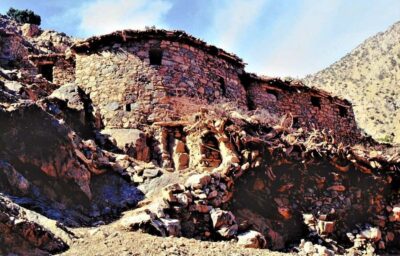
Agadir or Taghazout: Paradise Valley Atlas Mountains Tour
Read our review →
Agadir/Taghazout: Quad Bike and Sandboarding Tour
Read our review →
From Taghazout or Agadir: Marrakech Guided Day Trip
Read our review →