
Reviewed · MEDINA & SOUK TOURS
Marrakech: Guided Medina History & Culture Tour
Marrakech makes more sense when you walk it in the company of someone who can explain the clues around you. This tour moves from the Koutoubia Mosque and the old city gate through the Mellah, Bahia Palace, Ben Youssef Medersa, working souks, and finally Jemaa el-Fnaa, tying grand monuments to everyday life in the medina.
I like the route for two clear reasons: skip-the-line entry saves time at Bahia Palace and the medersa, and the guide leads you beyond the main shopping lanes into residential streets and local markets. Youssef is especially good at explaining Moroccan customs, pointing out details in the souks, and helping you get your bearings early in your stay.
The main drawback is value. At $65 per person, this costs more than a basic walking tour, and four hours on foot through crowded, uneven lanes can be tiring. The price makes the most sense if you want the palace and medersa explained properly, not simply photographed.
Key points at a glance
- Starts beneath Koutoubia Mosque: Meet at the small white Kubba Fatima Zohra mausoleum on Mohamed 5th Boulevard.
- Two major monuments included: Skip-the-line admission covers Bahia Palace and Ben Youssef Medersa.
- The route shows ordinary medina life: Residential lanes, a produce market, trade workshops, and local shopping areas are part of the walk.
- Youssef earns special praise: He is known for clear English, strong knowledge of Moroccan culture, useful shopping advice, and taking photos.
- The souks are about more than shopping: You see leather, wood, silver, bronze, copper, spices, and skilled makers at work.
- It ends at Jemaa el-Fnaa: The tour finishes in Marrakech’s central square, a useful place to continue exploring on your own.
Starting under Koutoubia Mosque
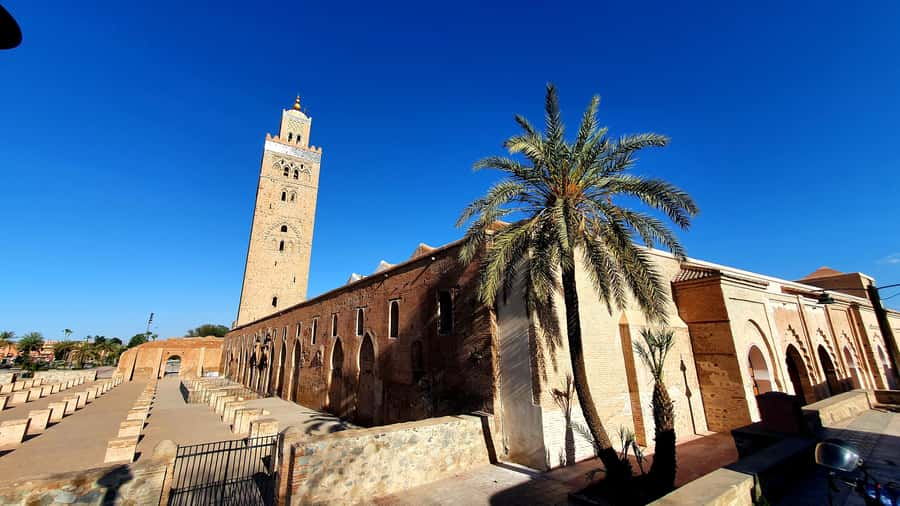
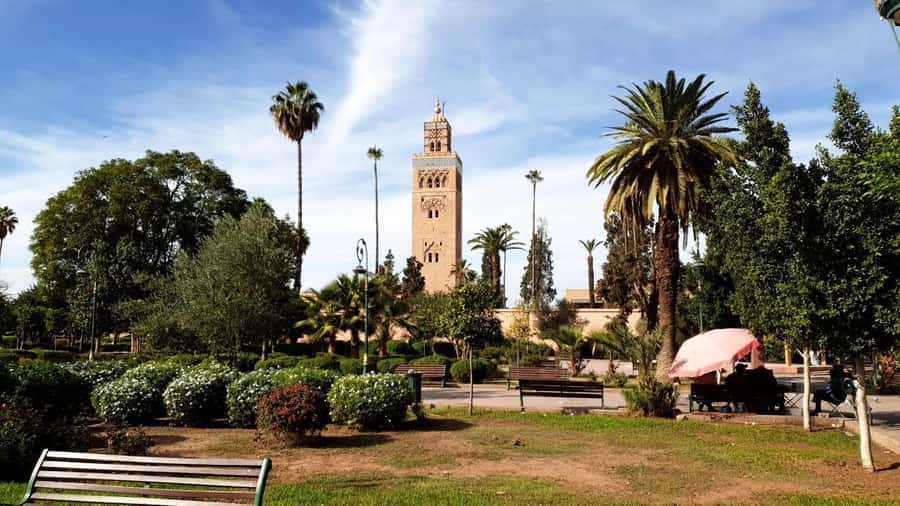
The meeting point is easy to identify once you know what to look for. Find the small white-domed mausoleum called Kubba Fatima Zohra at the foot of the Koutoubia Mosque tower, on Mohamed 5th Boulevard. Your guide should be wearing an official badge with a blue ribbon.
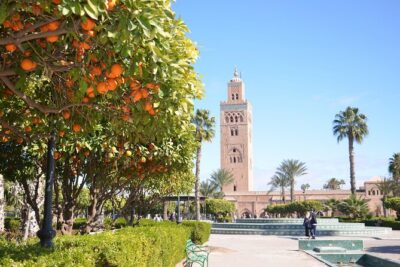
This is a good starting place because Koutoubia gives you the basic map of Marrakech. You begin in the gardens, hear about the city’s early development, and view the mosque from the outside. Non-Muslim visitors cannot tour the prayer hall, so this is an exterior visit rather than an indoor mosque tour.
The guide also points out the city’s first road and entrance gate. Those details help explain how Marrakech grew from a fortified settlement into the maze of lanes you are about to enter. Take a moment here to check your shoes, water, and phone battery. Once inside the medina, the route becomes much more crowded and less predictable.
Youssef is a particularly useful guide for this opening section. He speaks clear English and French, explains without rushing, and has a knack for showing small details that are easy to miss when you are looking only at the big buildings.
Other medina and souk tours in Marrakech people book:
- Marrakech: Bahia Palace, Saadian Tombs, Souk and Medina Tour
★ 4.7 · 4,974 reviews - Marrakech: Ben Youssef, Secret Garden, & Souks Walking Tour
★ 4.6 · 2,802 reviews - Marrakech: Colorful Medina Souks Guided Walking Tour
★ 4.7 · 2,470 reviews
A short look at the Mellah and its produce market
After Koutoubia, the group walks toward the Mellah, Marrakech’s historic Jewish quarter. The stop is brief, about 15 minutes, but it adds an important side to the city’s story. Here you learn about Morocco’s Jewish heritage and see how the old quarter still functions as part of the city rather than as a preserved museum set.
The route also pauses at a busy fresh produce market. This is one of the better moments for seeing daily life at close range. You may find shoppers choosing food, vendors arranging goods, and locals handling errands in the same lanes used by residents for generations.
Do not expect a long market tour at this point. The schedule allows about 15 minutes, so think of it as a quick introduction before the grander architecture of Bahia Palace. Keep your belongings close and stay near the guide, since the medina’s lanes can fill quickly.
Bahia Palace, a lesson in Moroccan design
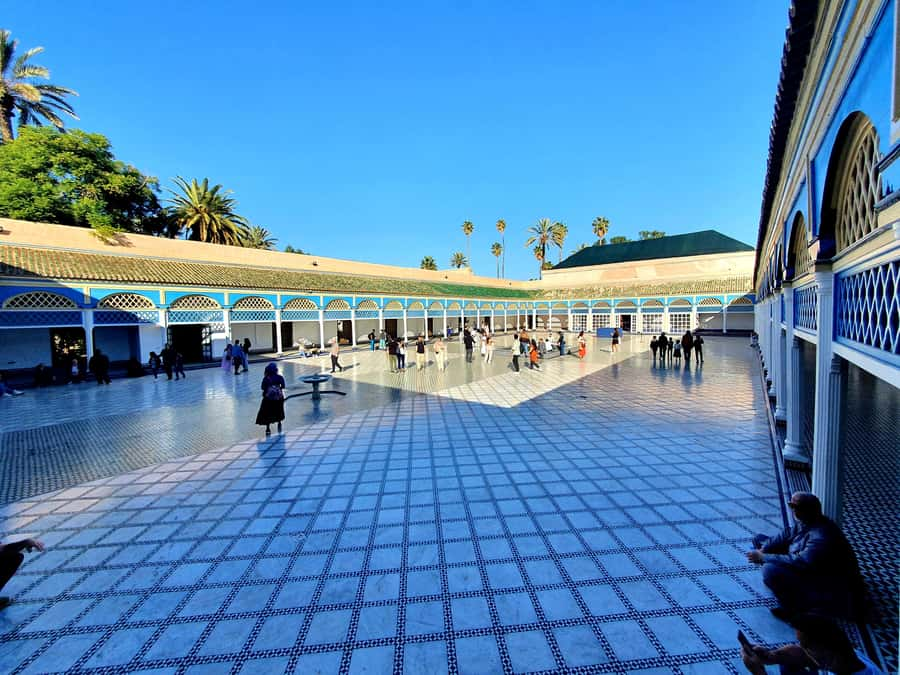
Bahia Palace receives about 45 minutes, with skip-the-line admission included. That can be a real advantage when the entrance is busy. Instead of spending part of your limited tour waiting outside, you can move into the palace with the guide and use the time for explanation.
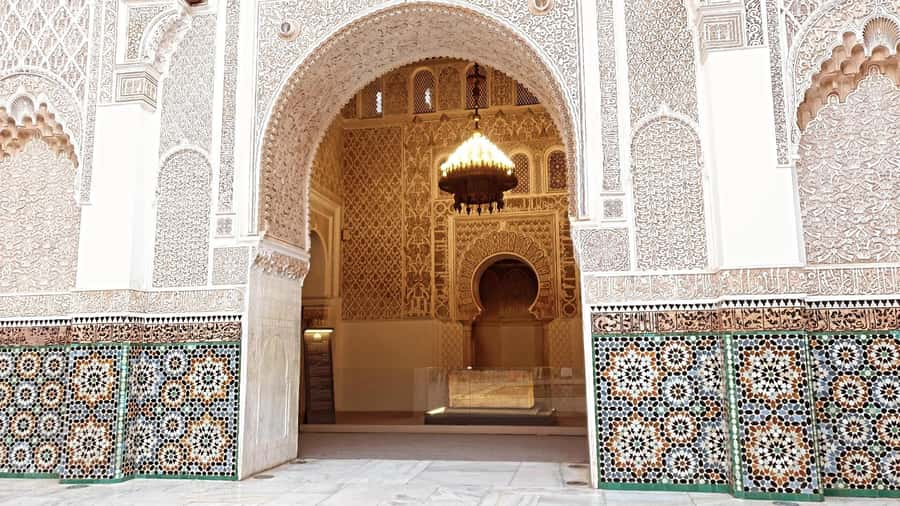
The palace is a maze of Andalusian-style riads, patios, gardens, fountains, reception rooms, and shaded passages. The pleasure here is not one single grand hall. It is the way the building reveals itself in pieces as you move from one court to another.
Look closely at the decoration:
- Zellij mosaics arranged in precise geometric patterns
- Carved stucco with Arabic inscriptions
- Cedar ceilings
- Ornate gates and arabesque details
- Fountains and patios built for shade and calm
A guide adds value because the decoration can blur together when you see it quickly. Youssef has a strong reputation for explaining the meaning and purpose of details rather than simply naming them. He also allows time for photographs, which matters in a place where every doorway seems designed for a picture.
The palace can be busy, and the 45-minute visit will not cover every corner at a leisurely pace. If you enjoy architecture, keep your camera ready but listen first. The best details are often overhead or tucked into a side passage.
Residential lanes away from the main tourist flow
The walk from Bahia Palace to Ben Youssef Medersa takes about 20 minutes. This is not dead time between attractions. The route leads through more typical residential neighborhoods, where the medina feels less arranged for sightseeing.
You see the practical side of old-city life: homes, small shops, everyday shopping, and lanes used by residents. The experience is valuable because it shows how the medina works as a living neighborhood. Marrakech is not only palaces and souvenir stalls. People live, work, and shop here every day.
This part also explains why comfortable shoes are essential. The tour covers a lot of ground, and the lanes can be uneven. Wheelchair users cannot take this tour, and anyone with limited mobility should think carefully before booking. The route has no vehicle transfer to break up the walking.
A guide is most useful here when the streets stop looking obvious. Youssef has been praised for taking groups into areas they might not choose to enter alone, while still keeping the pace calm and the route clear. That makes this a strong early-stay activity if you want to feel more at ease in the medina.
Other walks through the old town in Marrakech:
- Marrakech: Saadian Tombs & Bahia Palace, Medina Guided Tour
★ 4.6 · 1,989 reviews - Marrakech Monuments & Souks 3-Hour Tour
★ 3.8 · 1,540 reviews - Marrakech: Bahia Palace, Madrasa Ben Youssef and Medina Tour
★ 4.7 · 1,347 reviews - Marrakech: Madrassa Ben Youssef, Secret Garden & Medina Tour
★ 4.8 · 1,303 reviews
Ben Youssef Medersa and the old education system
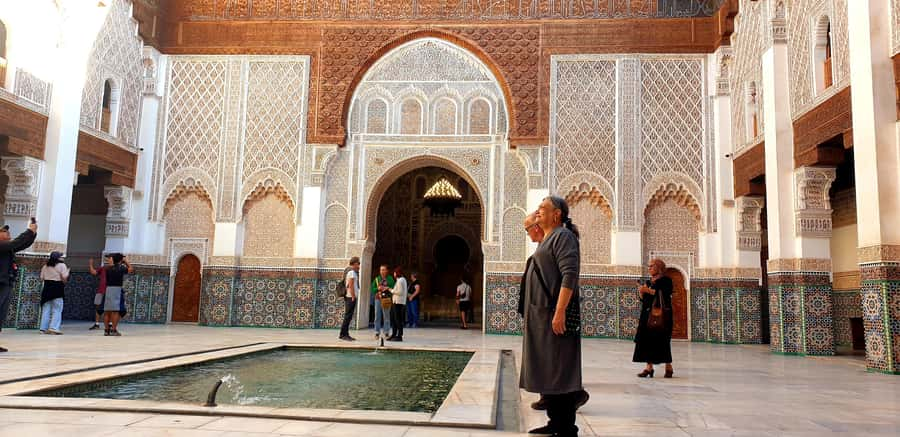
The Ben Youssef Medersa gets another 45-minute visit, again with skip-the-line entry included. This former Islamic school is one of the tour’s major architectural stops and a good counterpoint to Bahia Palace.
You visit the prayer hall, ablutions room, and students’ quarters. The guide explains Muslim practice and the traditional education system, giving the building a human purpose beyond its decoration. You begin to see how students once lived and studied within the school rather than viewing it as just a photogenic courtyard.
Arabo-Islamic design is everywhere here. Geometric tilework, carved plaster, woodwork, and careful proportions reward a slow look. The courtyard is likely to attract the most attention, but do not skip the smaller spaces. The ablutions room and student quarters help you understand how the medersa operated.
The stop is long enough for a guided explanation and photographs, though not for an unhurried architectural study of every surface. If you have a serious interest in design, listen for the guide’s specific details and use your free moments for close-up images.
Working souks: leather, wood, metal, and trade
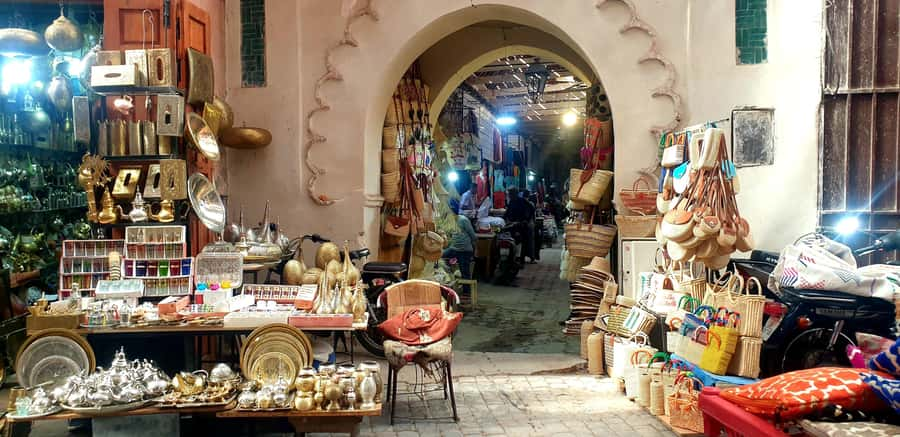
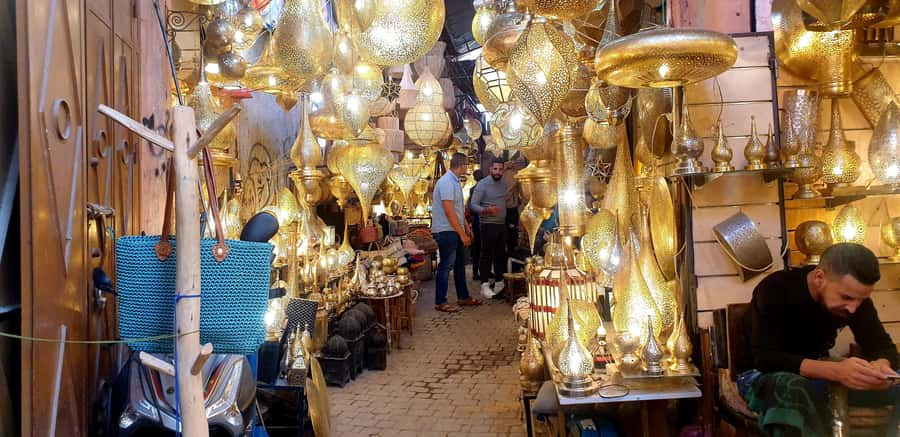
From the medersa, the route enters the more active craft areas. One stop takes you past the leather souk and workshops. You may see craftsmen working with leather, wood, silver, bronze, and copper, depending on what is active at the time.
This is where the tour becomes especially practical. Instead of walking through the souks without knowing what you are seeing, you learn how the market is organized by trade. The guide can help you distinguish a working shop from a showroom and explain what different materials are used for.
The old market system is not quiet or polished. There is noise, movement, bargaining, and merchandise being handled by many people at once. That is part of the point. Keep your group in sight, step aside when workers need to pass, and do not stop in the middle of a narrow lane for photographs.
You are not required to buy anything. Still, the guide’s advice can be useful if you want to shop. Youssef has been praised for explaining where to buy and for giving clear tips about the goods. Treat the shopping element as optional. The tour is strongest when you use the souks to understand how Marrakech’s trades function, not when you feel pushed to make a purchase.
Rahba Kedima and the spice stop
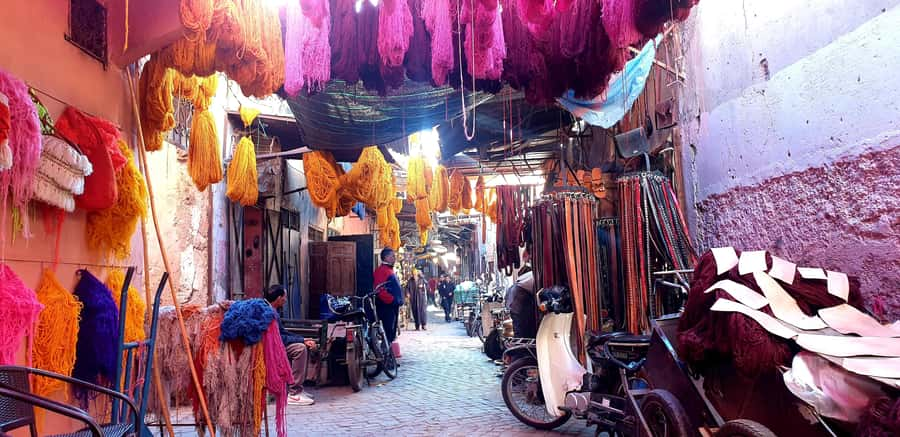
The route continues to Rahba Kedima, often called the old spice square. The schedule allows about 15 minutes here for a break, free time, regional food, scenic views, and a look at nearby workshops.
This is a good place to pause after the palace, medersa, and long walks. The square offers a different kind of visual experience, with colorful displays and the intense mix of smells and textures associated with a Moroccan market. The guide can help put the goods in context, especially if you are unsure what is meant for cooking, scent, decoration, or traditional use.
Keep your expectations sensible. The stop is short, and it is not a dedicated food tasting or cooking class. You will have time to look around, take pictures, and perhaps browse, but not to study every stall in depth.
Souk Semmarine and Moroccan craftwork
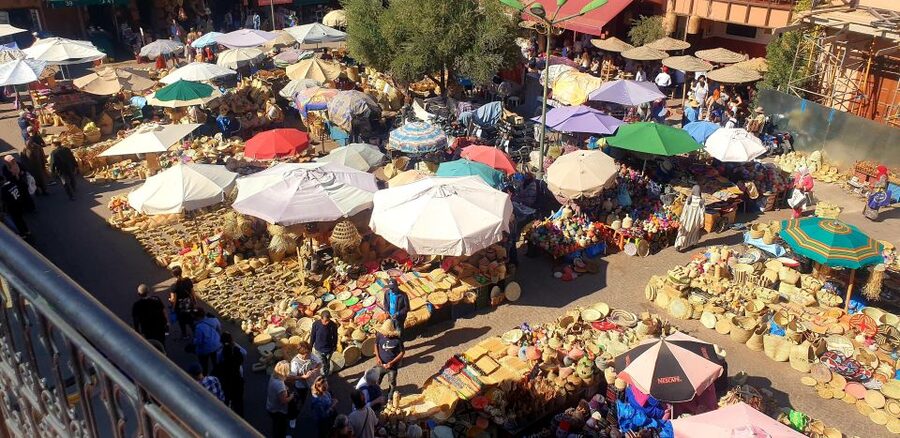
Souk Semmarine follows for about 15 minutes. This is one of the city’s best-known shopping lanes and a showcase for Moroccan artisans. It has long attracted artists and designers looking for ideas, but you do not need a design background to enjoy it.
The value of passing through with a guide is that you can focus on technique rather than just color. Notice the handwork, the materials, and the way different trades cluster together. Ask questions if you want to know how an item is made or where a material comes from.
Shopping here can be tempting, but you should feel no obligation to buy. Prices and quality vary, and the short stop is better suited to orientation than to a major purchase. If you find something you like, use the guide’s local advice and take your time before agreeing to a price.
Ending at Jemaa el-Fnaa
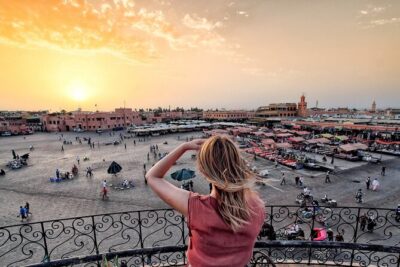
The final walk takes about five minutes and ends at Jemaa el-Fnaa, the beating heart of Marrakech. The square is known for street artists, games, traditional performances, and the constant movement of people crossing between the medina and the city beyond.
The scheduled visit here is only about 10 minutes, so the tour gives you an introduction rather than an evening program. That is sensible. Jemaa el-Fnaa changes with the time of day, and you may want to return later to see more of its food stalls and performers.
Ending here is convenient. You can continue exploring, arrange your own meal, or use the square as a reference point for the rest of your stay. The guide’s final advice can also help you make sense of the lanes you have just walked.
What the $65 price really covers
At $65 per person, this is not the cheapest way to see the medina. You are paying for a four-hour guided route, two skip-the-line admissions, bottled water, and a guide who connects the monuments with ordinary city life.
The value is strongest for a first visit. Bahia Palace and Ben Youssef Medersa are easy to appreciate visually, but their design, religious setting, and social purpose are harder to understand without explanation. The walk also reaches residential areas and craft zones that you might pass through without knowing what you are seeing.
The price is less attractive if you mainly want independent shopping or a quick photo tour. You will cover a lot of ground, and the pace may feel full. One advantage is that the outing can sometimes run longer when the guide spends extra time explaining or answering questions, but you should plan around the advertised four hours rather than count on an extension.
You receive two small bottles of water, or one large bottle, per person. Bring more water if the weather is warm. Wear shoes that can handle several hours of walking, and dress comfortably for a route that moves between open squares, shaded lanes, and busy market areas.
Who should book this walk
I would choose this tour if you are visiting Marrakech for the first time and want a clear introduction before exploring alone. It suits people who enjoy architecture, local customs, markets, and street-level detail in equal measure.
It is also useful for anyone who feels unsure about entering the medina independently. A guide helps you move through the lanes with a purpose and points out areas you may otherwise miss. Youssef is a strong choice if he is assigned to your group, especially if you want explanations in English or French and practical shopping advice.
You may want a different experience if you dislike crowds, long walks, or market pressure. The tour is not wheelchair accessible, and the schedule does not leave large blocks of free time at each attraction. It is a guided overview, not a slow photography session or a private architectural study.
Private groups are available, which can make it easier to ask questions and adjust the pace. The tour also allows free cancellation up to 24 hours before departure, and you can reserve now and pay later, useful when your Marrakech plans are still shifting.
Should you book the Marrakech Medina History and Culture Tour?
Book it if you want the main sights explained, fast entry at the two key monuments, and a look at the real working medina beyond the postcard views. The route is well balanced: Koutoubia and the Mellah provide context, Bahia Palace and Ben Youssef Medersa supply the architecture, and the souks show how the city works today.
Skip it if $65 feels high for a walking tour or if you prefer to set your own pace. For most first-time visitors, though, the combination of history, residential lanes, craft workshops, and practical guidance makes the cost defensible. Start early in your stay, wear good shoes, and treat the shopping stops as cultural observations first and buying opportunities second.
FAQ
How long is the Marrakech Medina History and Culture Tour?
The advertised duration is four hours. The route includes several walking sections and may take longer if the guide spends extra time answering questions or explaining sights.
Where do I meet the guide?
Meet at Kubba Fatima Zohra, the small white mausoleum at the foot of the Koutoubia Mosque tower on Mohamed 5th Boulevard. The guide should wear an official badge with a blue ribbon.
Which languages are available?
The live guide service is available in English and French.
Does the tour include entry to Bahia Palace?
Yes. Skip-the-line entry to Bahia Palace is included.
Does the tour include entry to Ben Youssef Medersa?
Yes. Skip-the-line entry to Ben Youssef Medersa is included.
Is bottled water provided?
Yes. You receive either two small bottles or one large bottle per person.
Is the tour suitable for wheelchair users?
No. The tour is not suitable for wheelchair users because it involves extensive walking through medina lanes and market areas.
Can I book a private group?
Yes. A private group option is available.
More history and heritage in Marrakech
- Marrakech Historical and Cultural Tour – Half Day City Tour
★ 4.5 · 1,180 reviews - Marrakech: Historical Discovery Tour
★ 4.1 · 87 reviews - Marrakech: Day Trip to the Beautiful and Historic Essaouira
★ 4.3 · 39 reviews - From Marrakech: Essaouira Full day trip, beach and History
★ 4.9 · 26 reviews
Just added in Marrakech
- Quad Ride In The Agafay Desert★ 5.0 · 39 reviews
- Quad Biking Agafay desert★ 5.0 · 20 reviews
- Marrakech: Tailor-Made City Tour With Your Own Private Guide★ 4.9 · 236 reviews
- Surf Training and Lunch on Essaouira Day Trip from Marrakech★ 4.9 · 51 reviews
- Essaouira: Surf Trip from Marrakech★ 4.9 · 31 reviews
- Marrakech palm grove: Sunset camel ride★ 4.8 · 194 reviews
- Marrakech: Sunrise Desert Tour with Camel Ride and Breakfast★ 4.4 · 36 reviews
- Marrakech : Agafay Desert Sunset Camel Ride & Luxury Dinner★ 4.3 · 39 reviews
Medina & Souk Tours, compared.
Bahia Palace, Saadian Tombs, Souk and Medina Tour
Read our review →
Ben Youssef, Secret Garden, & Souks Walking Tour
Read our review →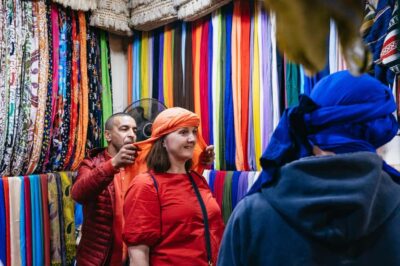
Museum, Al Attarine Madrasa & Tannery and Medina Tour
Read our review →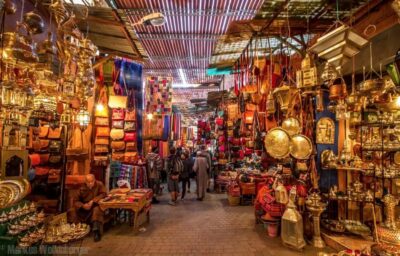
Bahia Palace, Madrasa Ben Youssef and Medina Tour
Read our review →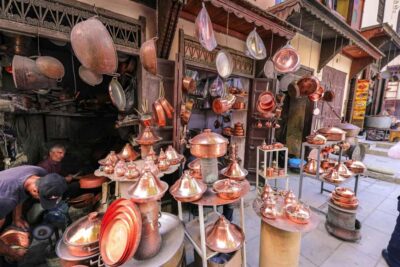
Explore Fes: Unforgettable Guided Walking Tour of the Medina
Read our review →Browse the lists this tour appears in