
Reviewed · CYCLING TOURS
Marrakech : Electric Bicycle City Tour
Marrakech makes the most sense when you see its old and new sides together. This electric bike tour carries you from Koutoubia Mosque and the Medina to modern Gueliz and the olive groves of Menara Gardens, with guides such as Walid, Oualid, and Ali leading the way. I like the range of the route, and I like that the electric motor takes the sting out of the heat and distance.
The small group, limited to six people, is another real plus. Your guide can watch the traffic and answer questions without shouting across a crowd. The main caution is the riding itself: Marrakech traffic is busy, and the Medina lanes can feel tight and confusing, so you should be comfortable on a bike in shared streets.
Key points to know before you book
- Three hours from old Marrakech to modern Gueliz: You cover several very different parts of the city in one outing.
- Small groups of up to six: Guides can keep a closer eye on you through traffic and narrow Medina lanes.
- Electric assistance matters: The motor makes longer distances and warm weather much easier.
- Walid, Oualid, and Ali are frequently assigned guides: Ask who is leading your departure if you have a preference, but guide availability can vary.
- The meeting point is at the Sofitel entrance: Find the EcoScooter parked in front of the main entrance on Avenue Echouhada.
- Not a quiet cycle path tour: You ride on city roads and through crowded lanes, so confidence on two wheels is important.
Why an electric bike is a smart way to see Marrakech
Marrakech is spread across more than the famous square and souks. The old city, the French-era quarter of Gueliz, and the gardens beyond the center each feel different. Walking between them takes time, while a taxi gives you little sense of the streets between the sights.
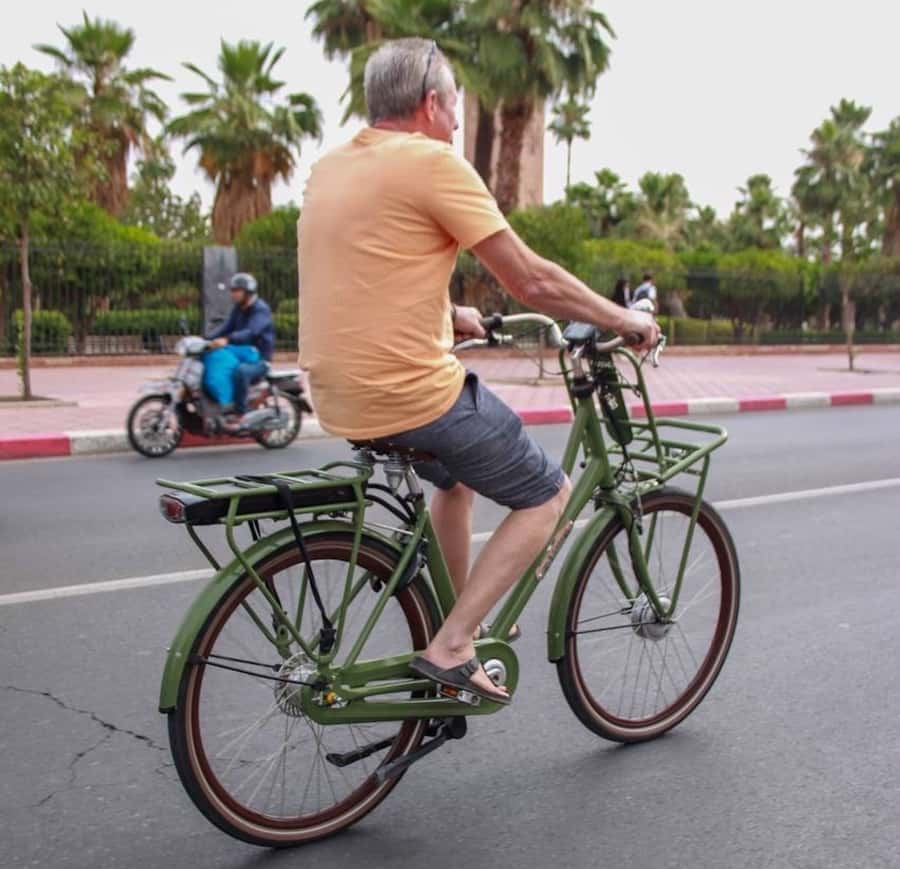
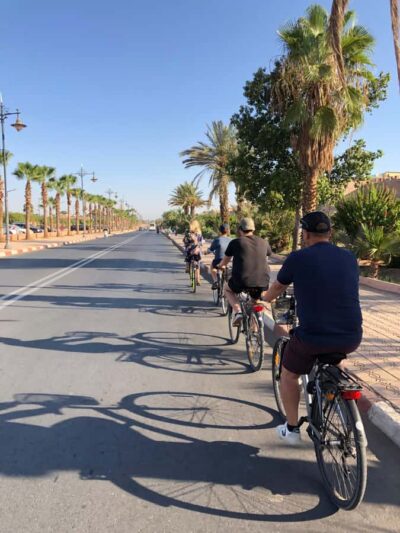
An electric bike fills that gap nicely. You still move at street level, but you can cover more ground without arriving soaked in sweat. The electric assistance is especially useful in warm weather and on a three-hour route. Several departures have also used electric scooters for people who found the bikes too large, though you should treat that as a possible adjustment rather than a guaranteed option.
The bikes are quiet, which helps in places where a noisy vehicle would feel out of place. You pass through streets at a human pace, with time to notice doorways, shop fronts, courtyards, and the changing color of the city walls. At the same time, you must share space with cars, mopeds, pedestrians, and other cyclists.
That combination makes this an active sightseeing tour, not a passive ride. I would choose it early in a Marrakech visit because it gives you a useful map of the city. After three hours, the Medina, Gueliz, Koutoubia, and Menara Gardens are no longer isolated points on a guidebook page.
Other rides on two wheels around Marrakech:
- Marrakech: Cultural Bicycle Tour with Pastry and Tea
★ 4.8 · 583 reviews - Marrakech: Bicycle Tour with a Local Guide
★ 4.7 · 495 reviews - Cycling Adventure in Marrakech
★ 5.0 · 289 reviews
Starting at the Sofitel and reaching Koutoubia Mosque
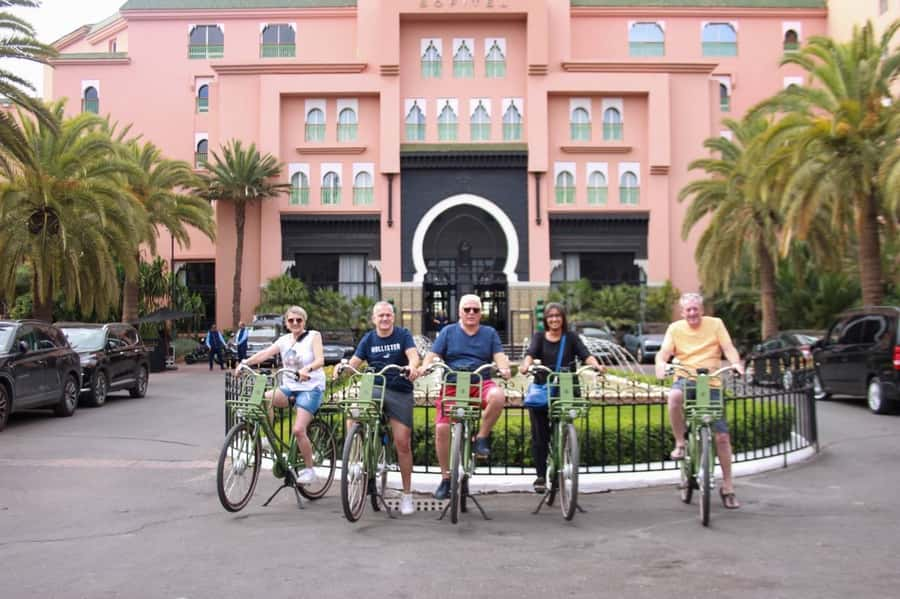
The meeting point is in front of the Sofitel on Avenue Echouhada, where you should look for the EcoScooter parked near the main entrance. This detail matters because the map location can be unclear. Go to the hotel’s main entrance rather than searching around the wider avenue, and ask staff to call the guide if you cannot find the group.
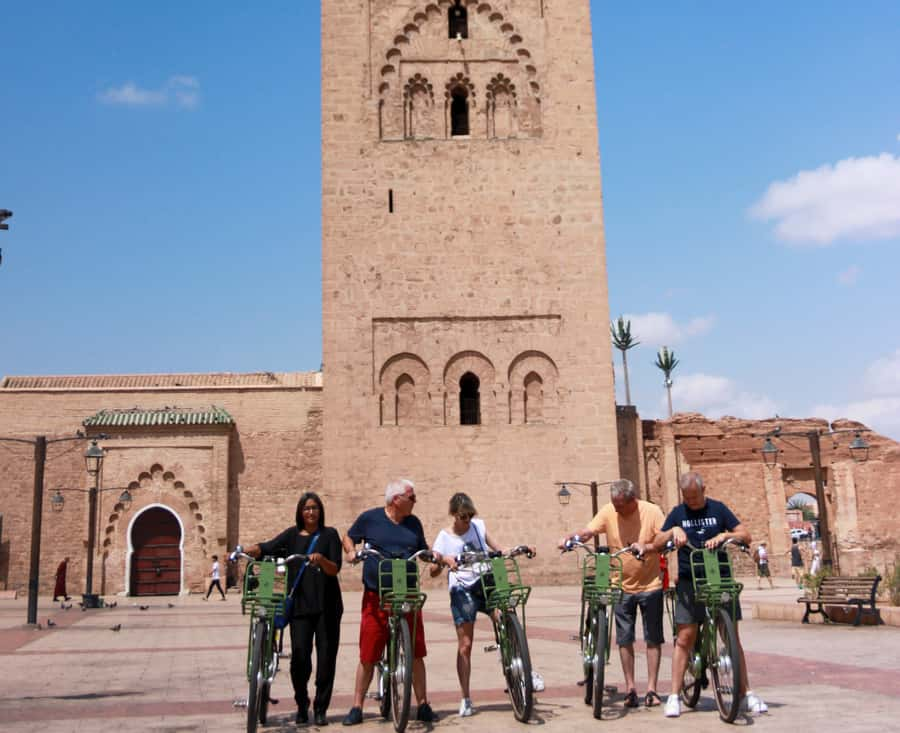
Once everyone is assembled, the guide gets you moving toward Koutoubia Mosque. The mosque is one of Marrakech’s most recognizable landmarks, with its tall minaret visible from many parts of the city. It provides a useful first orientation point before the route turns toward the old center.
You should expect a short stop rather than a long formal visit inside the mosque. The value here is the setting and the introduction to the city’s historic core. Your guide can explain what you are seeing, answer basic questions, and set the rhythm for the rest of the ride.
Guides Walid, Oualid, and Ali receive particularly strong praise for being friendly, patient, and careful with groups. Names are spelled several ways, so do not worry if your confirmation uses a slightly different version. The important point is that the guide’s role is central here, especially when the route shifts from open streets to tighter ones.
Jamaa El Fna, the souks, and the Medina
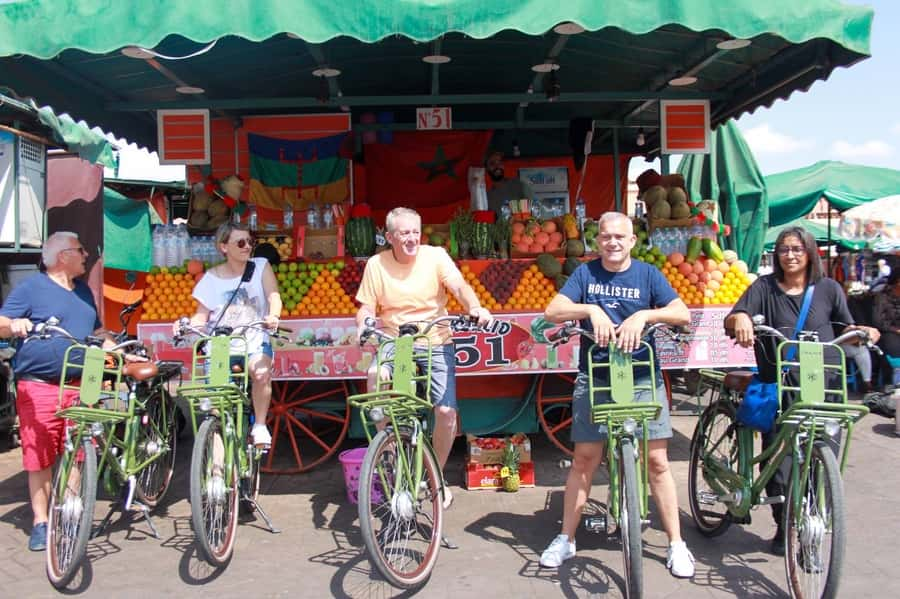
From Koutoubia, the tour heads toward Jamaa El Fna, Marrakech’s great public square. It is a place of movement, performance, commerce, and constant activity. On a bicycle, you see the square as part of a working city rather than simply as a photo stop.
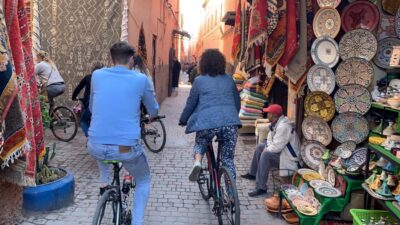
The route then enters the souks and the Medina, including the stretch from Bab Ftouh to Bab Laksour. These narrow, winding streets are the most memorable part of the outing for many people, but they are also the section that demands the most attention.
Here, mopeds, pedestrians, bicycles, merchants, and visitors all use limited space. Your guide rides ahead and helps you read the flow of traffic. You may need to slow down sharply, keep close to the group, or get off and walk for a short stretch. One rider specifically found the souks tiring and uncomfortable on a bicycle, while other riders described the same section as exciting and fun.
That difference comes down to confidence. If you regularly ride in traffic, you will likely enjoy the challenge. If you are uneasy on a bike, the Medina may feel like too much stimulation. Tell the guide early if you need a slower pace. The small group makes that conversation easier than it would be on a large bus or crowded walking tour.
The Medina section also gives the tour its strongest sense of place. You are not looking at Marrakech from behind glass. You are close to the walls, shop entrances, passing carts, and everyday movement. The electric motor helps you keep going, but it does not remove the need for awareness.
The route is not designed as a shopping stop, so you should not expect long periods to browse the souks. It is better understood as a moving introduction. Use a separate visit later if you want to buy spices, leather goods, ceramics, or textiles at your own pace.
A pause for coffee and a chance to ask questions
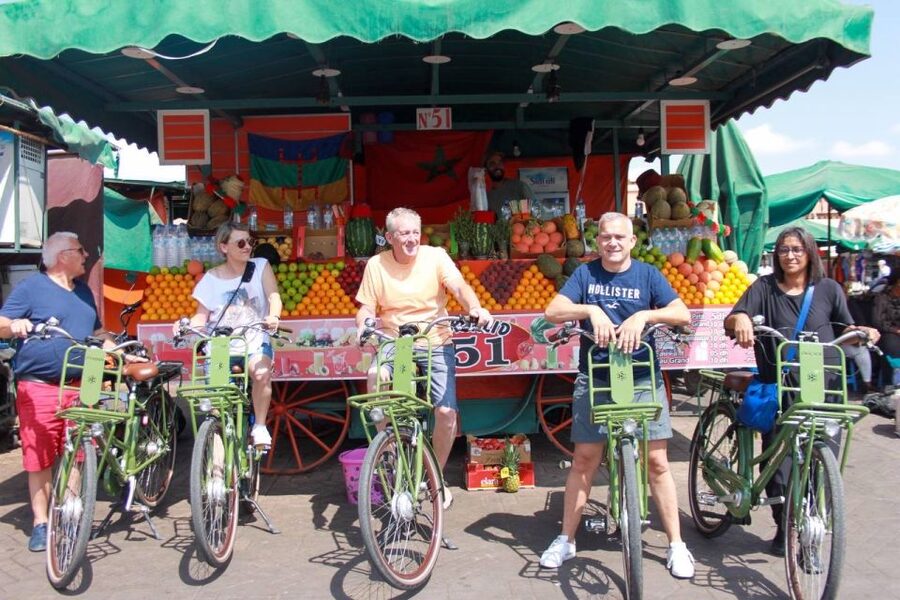
At some point, the guide may stop for a coffee. This break is mentioned as a welcome part of the ride, and it gives you a chance to settle down after the more demanding Medina section.
The coffee stop also has practical value. You can ask about places to eat, sights to visit later, or areas of Marrakech you want to explore on foot. Guides are often generous with tips about the rest of your stay, and Walid is frequently praised for offering useful advice as well as city information.
Do not expect a full meal or a long café visit. Food and drinks are not included in the price. Think of this as a short refreshment break, with any purchase paid separately.
Other ways to see Marrakech in a day:
- Marrakech: Private Guided Half-Day City Tour
★ 5.0 · 1,249 reviews - Marrakech Historical and Cultural Tour – Half Day City Tour
★ 4.5 · 1,180 reviews - Marrakech City Tour: Private Custom-Made
★ 4.5 · 596 reviews - Highlights of Marrakech: Private Half-Day City Tour
★ 5.0 · 478 reviews
Gueliz, Marrakech’s modern quarter
After the old city, the route turns toward Gueliz. The change can be striking. Instead of the tight lanes and traditional souks, you find broader streets, craft shops, stylish stores, and exclusive boutiques.
Gueliz helps explain modern Marrakech. It is not a replacement for the Medina, and the tour does not treat it as one. It shows how the city has grown beyond its historic walls and gives you another part of town to return to later.
This is one of the strongest reasons to choose the bike tour instead of a short Medina-only walk. In a few hours, you see the contrast between old and new Marrakech without arranging separate transport. The bike also lets you notice the transitions between districts rather than jumping from one destination to another.
You may find Gueliz less atmospheric than the Medina, especially if your main interest is traditional architecture and souk life. Its value is comparison. The route shows that Marrakech is not one single experience, and the modern quarter gives the day a useful change of pace.
Menara Gardens and the olive groves
The final major stop is Menara Gardens, built during the Saadian period in the sixteenth century. The gardens are associated with orchards and olive groves, offering a more open setting after the close streets of the old town.
This part of the route gives your eyes a rest. You have moved through traffic, lanes, shops, and city blocks, and now the ride reaches a quieter area with trees and wider views. The gardens also add historical context without turning the outing into a long lecture.
The stop is relatively short, so you should not expect an extended garden visit or a full historical tour. Its purpose is to show another side of Marrakech and give the route a calmer ending before returning to the Sofitel.
I like the way the itinerary finishes here. The day begins with famous landmarks and crowded streets, then moves through the contemporary quarter before reaching open orchards and olive trees. That sequence gives you a clearer feel for the city’s shape than a list of central sights would.
How safe and difficult is the riding?
The guides receive repeated praise for handling traffic carefully. Several riders felt well looked after on main roads and in the Medina, and families with teenagers found the guide’s supervision reassuring. That is important because Marrakech traffic can feel disorderly if you are not used to it.
Still, a guide cannot make the streets empty. You need to pay attention, follow instructions, and be willing to stop when asked. The tour suits a person who can ride a bicycle confidently in ordinary traffic. It is not suitable for people with mobility impairments, and children must be at least 120 centimeters tall.
Bike size is worth considering. Some shorter riders found the bikes too large or heavy and switched to electric scooters. Others managed well with help from the guide. If you are near the minimum height or have concerns about handling a heavy bike, contact the operator before booking and ask what alternatives are available for your departure.
The route may feel thrilling, especially when you enter the Medina. One rider described it as scary, exhilarating, and survivable, which is a fair description of the experience for someone not used to Marrakech streets. That is part of the appeal, but it is also the clearest warning.
Price, group size, and overall value
At $32 per person, the three-hour tour is good value if you want orientation and transport in one package. You receive an electric bike rental and a guided city route covering the old town, modern Marrakech, and Menara Gardens. You are paying not only for the bike, but also for the local guide who helps you move through streets you might struggle to understand alone.
The small group size, capped at six, improves that value. A guide can keep the group together, watch for traffic, and adjust the pace. You get more personal attention than on a large sightseeing vehicle, and the bike allows access to lanes where a bus or standard car could not go.
The price does not cover food or drinks, and hotel pickup and drop-off are not included. You need to reach the Sofitel yourself and budget for any coffee or refreshments. The tour description also presents half-day and full-day choices, while the listed activity is three hours, so check the exact option and duration at booking.
Free cancellation is available up to 24 hours before the start for a full refund, and you can reserve now and pay later. Those terms are useful if your Marrakech plans are still shifting.
Who will get the most from this tour?
I would recommend it to first-time visitors who want a fast, practical orientation. It is also a good fit for couples, families with older children, and small groups who like active sightseeing but do not want to spend the whole day walking.
It works especially well for people who want to compare the Medina with Gueliz. You will see traditional lanes, modern shops, major landmarks, and garden areas in one compact outing. It can also help you decide where to return during the rest of your stay.
I would be cautious if you dislike traffic, have limited cycling experience, or want a slow photo tour. The Medina can be demanding, and the electric motor does not solve the problem of crowded lanes. You should also avoid assuming that the ride will be completely relaxed simply because the bike is powered.
Guided tours are offered in English, French, and Arabic. The guide names commonly associated with the experience include Walid, Oualid, and Ali. If a particular guide is important to you, ask when booking, but do not assume that person will be available.
Should you book this Marrakech electric bike tour?
Book it if you want to cover a lot of Marrakech in three hours and feel comfortable riding around traffic. The best parts are the range of the route, the small group, and the guide’s help in places where the city can feel confusing.
Skip it if you want a quiet, unhurried walk or if riding through busy streets sounds stressful. For everyone else, $32 buys a useful first look at Marrakech, with enough local contact and street-level movement to make the city easier to understand afterward.
FAQ
Where does the electric bike tour meet?
The meeting point is in front of the Sofitel on Avenue Echouhada in Marrakech. Look for the EcoScooter parked near the hotel’s main entrance.
How long does the tour last?
The listed activity lasts three hours. Availability and starting times should be checked when booking.
Which languages does the guide speak?
The tour is available with a live guide speaking French, English, or Arabic.
How many people are in the group?
The group is limited to six participants.
What places does the route visit?
The route includes Koutoubia Mosque, Jamaa El Fna Square, the souks, the Medina from Bab Ftouh to Bab Laksour, Gueliz, and Menara Gardens.
Is food or drink included?
No. Food and drinks are not included, although a coffee stop may be part of the route. Any refreshments are paid for separately.
Who should not take this tour?
The tour is not suitable for people with mobility impairments or anyone under 120 centimeters tall. You should also be comfortable riding in city traffic and narrow, busy streets.
Just added in Marrakech
- Quad Ride In The Agafay Desert★ 5.0 · 39 reviews
- Quad Biking Agafay desert★ 5.0 · 20 reviews
- Marrakech: Tailor-Made City Tour With Your Own Private Guide★ 4.9 · 236 reviews
- Surf Training and Lunch on Essaouira Day Trip from Marrakech★ 4.9 · 51 reviews
- Essaouira: Surf Trip from Marrakech★ 4.9 · 31 reviews
- Marrakech palm grove: Sunset camel ride★ 4.8 · 194 reviews
- Marrakech: Sunrise Desert Tour with Camel Ride and Breakfast★ 4.4 · 36 reviews
- Marrakech : Agafay Desert Sunset Camel Ride & Luxury Dinner★ 4.3 · 39 reviews
Cycling Tours, compared.
Guided City Cycling Tour – Culture, Colors & Charm
Read our review →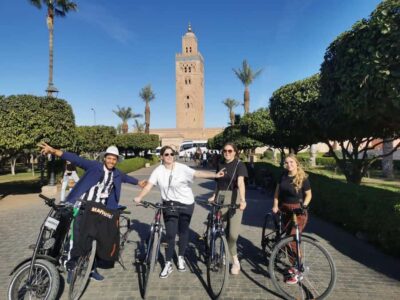
Cycling Tour in Palm Groove with Local Breakfast
Read our review →
Guided Cycling Adventure in Casablanca with Licensed Tour Guide
Read our review →Browse the lists this tour appears in